
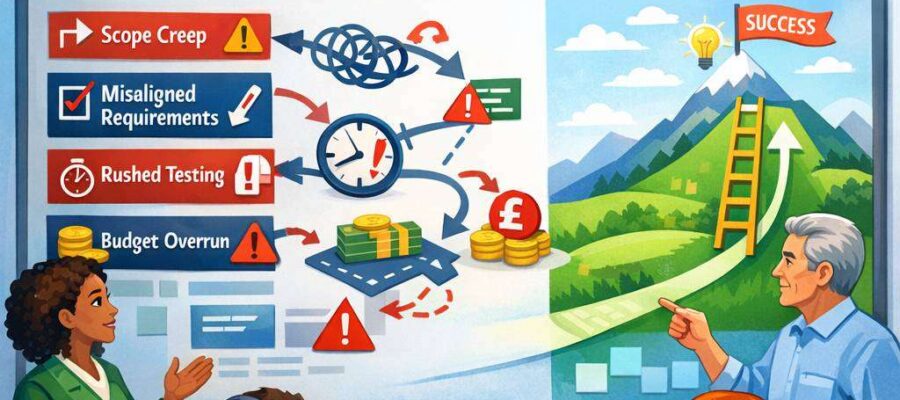
In the fast-paced world of product development, even well-meaning teams can stumble into familiar traps. As a seasoned practitioner offering product development services and new product development consulting, I’ve seen what goes wrong and what to do about it. Here’s a practical guide to recognising common pitfalls and turning them into opportunities, using a friendly tone and actionable advice.
1. Skipping proper discovery and user insight
One of the biggest mistakes organisations make is rushing into building a product without deeply understanding the problem, the user, and the market. Assumptions abounds, and you end up with features that nobody wants.
How to avoid:
- Invest time in qualitative and quantitative research early. Run interviews, surveys, and usability tests with real users.
- Create a clear problem statement and success criteria before drafting any spec.
- Validate ideas with quick prototypes or pilot studies. This is where new product development services can provide impartial, structured insights.
2. Overloading with features (feature creep)
In the zeal to beat competitors, teams often pile on features, losing sight of core user needs and creating a bloated product that is hard to use.
How to avoid:
- Define a minimal viable product (MVP) that delivers measurable value. Share the MVP scope with stakeholders and enforce a strict change-control process.
- Rely on user feedback loops rather than internal assumptions to decide which features survive.
- Use product roadmaps that prioritise impact, effort, and risk, not just ambition.
3. Inadequate prioritisation and roadmapping
Entrenched backlogs and unclear priorities lead to delays and wasted development cycles. When teams don’t agree on what to build first, momentum stalls.
How to avoid:
- Align on a clear set of success metrics and tie each feature to one or more of them.
- Apply a simple prioritisation framework (e.g., RICE, MoSCoW) to make decisions transparent.
- Maintain a living roadmap that reflects learnings from each sprint and customer feedback.
New product development demands a systematic approach that blends market insight, design thinking, and rapid experimentation. Teams must validate concepts early, iterate based on feedback, and align with business goals to minimize risk. Creative collaboration across disciplines accelerates problem solving and reduces time-to-market. Metrics and milestones keep efforts focused, while customer-centric testing ensures relevance. https://forward-npd.com/ This disciplined process helps organizations transform ideas into successful offerings, driving growth and competitive advantage through continuous innovation.
4. Poor stakeholder alignment
With multiple departments involved—engineering, design, marketing, sales, legal—misalignment is a risk. Conflicting goals can derail timelines and budgets.
How to avoid:
- Establish a cross-functional governance model from the outset. Regular demos and decision forums help keep everyone on the same page.
- Use a single source of truth for requirements, specifications, and milestones.
- Engage customers and end-users in reviews to ensure the product remains user-centred.
5. Insufficient validation of market and business viability
A technically sound product that fails in the market is a costly outcome. Many teams underestimate the importance of business and market viability.
How to avoid:
- Build a business model canvas early, testing revenue, pricing, and cost structure.
- Run small-scale market pilots or beta programmes to observe real adoption and willingness to pay.
- Leverage new product development consulting to triangulate customer data, competitive intelligence, and financial viability.
6. Underestimating the importance of design and user experience
Great technical capability does not guarantee success if the product is hard to use or aesthetically unappealing. Design is not an afterthought.
How to avoid:
- Treat design as a strategic function, integrated from the start. Invest in user experience research and iterative design.
- Conduct usability testing with diverse user groups and iterate rapidly.
- Maintain a consistent brand and interaction language across all touchpoints.
7. Inaccurate cost estimation and timing
Underestimating development cost or misjudging the timeline is a common pitfall. Projects drift, budgets explode, and stakeholders lose confidence.
How to avoid:
- Build realistic budgets with contingency buffers for risk items.
- Use iterative development with bounded sprints and fixed milestones to keep delivery predictable.
- Track velocity and throughput, and adjust plans based on actual performance rather than ideal scenarios.
8. Compliance, risk, and governance gaps
Regulatory, safety, and data privacy considerations can derail a project if not addressed early. This is especially crucial for hardware, health tech, fintech, and consumer devices.
How to avoid:
- Map regulatory requirements early and integrate them into the product plan.
- Involve legal, security, and compliance SMEs in early design reviews.
- Establish risk registers and mitigation plans, revisiting them through each development cycle.
9. Inconsistent translation from idea to execution
Great ideas stall when there’s a gap between concept and implementation. Ambiguity in requirements leads to mismatched deliverables.
How to avoid:
- Create precise user stories, acceptance criteria, and success criteria for each feature.
- Use prototyping and proof-of-concept tests to validate feasibility before committing significant resources.
- Ensure clear handoffs between product management, design, and engineering.
10. Overreliance on external partners without governance
Many organisations rely heavily on external development teams or agencies. Without proper governance, quality, timing, and alignment can suffer.
How to avoid:
- Establish clear governance lines, metrics, and escalation paths with external partners.
- Demand transparent reporting, regular sprint reviews, and acceptance criteria tied to outcomes.
- Consider engaging a new product development consultant or using dedicated product development services to maintain control and alignment.
Practical steps you can take today
- Audit your current product development process against the pitfalls listed above and identify the top two areas for quick wins.
- Clarify the MVP and success metrics. Share them with all stakeholders and keep them visible in the team workspace.
- Initiate a cross-functional review session every sprint cycle to ensure alignment and early risk detection.
- Explore partnering with reputable product development companies or new product development consulting firms to inject discipline, especially in discovery, validation, and governance.
If you’re evaluating options for growth, you’ll find a range of services described as product development services, new product development services, or new product development consulting. Whether you’re in early-stage discovery or scaling post-launch, the right partner can help you avoid these common traps and accelerate your path to market success. By embedding rigorous discovery, prioritisation, and governance into your process, you’ll be better positioned to deliver products that users love and that meet your business objectives.