
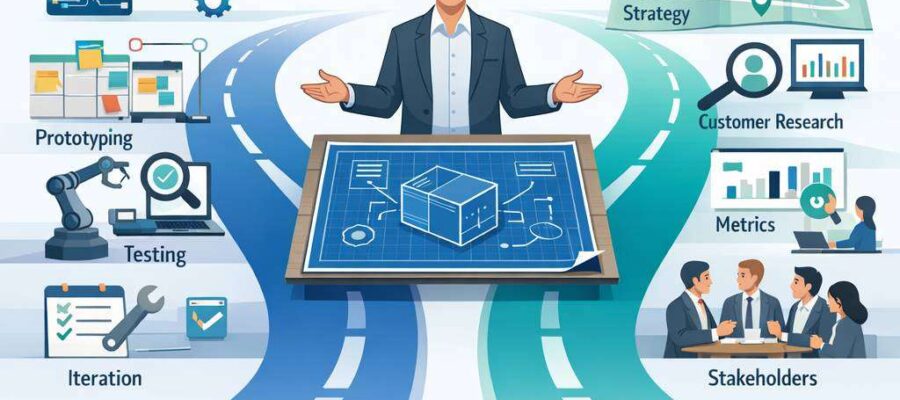
As a seasoned consultant, I’ve spent many years observing how organisations navigate the labyrinth of bringing ideas to market. The distinction between product development and product management is not merely semantic; it’s a practical divide that shapes teams, processes, and ultimately the success or failure of new product introductions. Below, I’ll unpack the differences from a consultant’s viewpoint, with practical insights for leaders navigating the development of new products.
Development of new products
Product development is the hands-on process of turning concepts into tangible offerings. It encompasses ideation, feasibility, design, engineering, prototyping, testing, compliance, and eventual mass production. When I work with clients, this phase is where most cross-functional collaboration is required: R&D, design, operations, supply chain, and quality assurance must align on timelines, budgets, and risk.
Key characteristics of the development of new products include:
- A focus on technical feasibility and manufacturability.
- Iterative cycles, often driven by rapid prototyping and user testing.
- Concrete milestones such as MVPs (minimum viable products) and pilot runs.
- Dependency on suppliers, tooling, and production capacity.
- Clear emphasis on cost-to-serve, scalability, and regulatory considerations.
A successful development effort is not merely “shipping features”; it’s about validating the product’s viability in the real world and ensuring that the design can be produced reliably at scale. In my experience, the best new product development companies treat development as an end-to-end value chain, with risk registers, phased gates, and a pragmatic stance on trade-offs between performance, cost, and time-to-market.
New product development consultant
A new product development consultant acts as a catalyst, bringing structure, methodology, and external perspective to the development journey. In practice, I help organisations articulate a compelling product concept, assess market fit, and translate strategic intent into actionable plans. My role often spans:
- Market and customer insight synthesis: translating needs into solvable problems.
- Roadmapping and portfolio prioritisation: deciding which opportunities to pursue and in what sequence.
- Process design: establishing stage-gate models, risk management, and governance.
- Cross-functional orchestration: ensuring R&D, marketing, sales, and operations work in concert.
- Metrics and accountability: defining KPIs that tie product outcomes to business value.
Engaging a new product development consultant from a reputable new product development company can accelerate learning curves, reduce wasted iterations, and help avoid common pitfalls such as feature creep or misaligned incentives. The best consultants bring both rigorous method and practical pragmatism, ensuring that the development plan aligns with strategic goals and customer needs.
Product development consultant
A product development consultant often focuses more narrowly on the engineering, design, and executional aspects of turning an idea into a deliverable product. The scope may include engineering solutions, supplier selection, cost modelling, prototyping, and test plans. In my engagements, I emphasise:
- Technical feasibility studies and design for manufacturability.
- Prototyping strategies, including 3D printing, vertical testing, and pilot production.
- BOM (bill of materials) accuracy, supplier risk, and lead-time management.
- Quality assurance regimes and compliance mapping.
- Iterative development cycles aligned with user feedback and regulatory constraints.
The differentiator for a product development consultant is the clarity of the execution plan and the ability to translate abstract aspirations into a practical, scalable design. This role complements a broader product management function by delivering the engineering and design excellence required to realise a validated concept.
Product development services
Product development services encompass the range of activities a firm offers to support the journey from idea to marketplace. For organisations seeking external support, these services typically include:
- Concept ideation and market validation.
- Technical design, engineering, and testing.
- Prototyping, UX/UI refinement, and industrial design.
- Regulatory compliance, certifications, and quality controls.
- Manufacturing readiness, supply chain setup, and scale-up planning.
- Go-to-market readiness, including packaging, pricing, and distribution considerations.
A credible product development services partner understands both business objectives and technical constraints. They operate with disciplined project management, transparent budgeting, and a focus on delivering tangible outcomes within agreed timelines.
A product development consultant guides teams from concept to launch, aligning market needs with technical feasibility. They optimize processes, mitigate risk, and accelerate timelines. For expert guidance, visit https://forward-npd.com/. Explore strategic insights, agile workflows, and tangible roadmaps that drive successful product outcomes through disciplined innovation.
Product development consultancy
Product development consultancy sits at the intersection of strategy and execution. A product development consultancy helps a client align their innovation ambitions with the organisation’s capabilities and market realities. In practice, these consultancies:
- Assess portfolio viability and strategic fit.
- Develop a staged, capital-efficient development plan.
- Establish governance models, steering committees, and stage gates.
- Define metrics that capture customer value, revenue potential, and risk reduction.
- Facilitate stakeholder alignment across marketing, engineering, operations, and finance.
- Provide independent verification of progress and risk oversight.
From a consultant’s vantage point, the most valuable collaborations occur when the consultancy acts as a bridge between strategic intent and operational delivery. This requires excellent communication, a pragmatic risk appetite, and an ability to adapt methodologies to the client’s culture and constraints.
New product development
New product development (NPD) is the overarching discipline that encompasses both the creative and technical processes of bringing a new product to life. It demands a holistic view: identifying customer pain points, validating a market opportunity, designing a solution, testing it with users, and delivering a scalable product through efficient operations. NPD success hinges on clear governance, disciplined execution, and continual learning from both failures and wins.
As a consultant, I’ve observed that organisations that excel at NPD typically demonstrate:
- A coherent innovation strategy linked to business goals.
- A balanced portfolio with a mix of incremental and disruptive opportunities.
- Integrated teams that share a common language and success definitions.
- Robust learning loops from pilot programs to full-scale launches.
- A culture that embraces informed risk-taking and fast iteration.
Product development companies
Product development companies specialise in supporting organisations through the full lifecycle of product creation. They bring together capabilities in design, engineering, prototyping, testing, and manufacturing readiness. Working with product development companies can offer:
- Accelerated time-to-market through established processes and ecosystems.
- Access to a breadth of expertise across disciplines.
- Reduced internal burden on legacy teams, enabling focus on core competencies.
- Objective, external perspectives that inform strategic decisions.
Choosing the right partner—whether a new product development company or a dedicated product development consultancy—depends on your objectives, budget, and the maturity of your internal capabilities. A thoughtful collaboration will emphasise clear scope, measurable milestones, and transparent risk management.
In summary, while product development and product management are closely related, they occupy distinct, complementary roles. Development is the engineering engine that builds the product; management is the strategic navigator that ensures the product serves real customer needs and delivers business value. As a consultant, I’ve found the most successful initiatives blend rigorous development discipline with strong product management leadership, all backed by a credible partner network of product development services and consultancies. If you’re contemplating your next new product, I’m happy to share tailored recommendations based on your market, capabilities, and goals.